AI
AI is now table stakes in CRM marketing. Learn why brands win by reducing friction between insight and execution—and how autonomous CRM drives growth.
At NRF this year, one thing was unmistakable: AI is no longer a novelty in CRM marketing. Nearly every vendor talked about it, and nearly every brand expected it to be part of the solution. What stood out, however, was not whether AI was present—but how differently it was being evaluated.
The conversation has clearly moved past “Do you use AI?”
Instead, brands are asking far more practical questions:
Does this actually reduce the day-to-day operational burden on my team?
Does it help us move faster from insight to execution?
Can we act while customer intent is still high?
This shift reflects a broader reality. Most CRM teams are not lacking intelligence. They already have dashboards, attribution models, and reports explaining what happened—and often why. The real challenge begins after the insight appears, when teams need to decide what to do next and execute quickly enough for it to matter.
As data volumes grow, decision-making often slows instead of accelerating. Insights live in one tool, audience definitions in another, and campaign execution in yet another. Each transition introduces friction, manual work, and delay—exactly what marketers can least afford.
This is where many AI-powered tools still fall short. They surface insights, but stop short of execution. Teams are left to interpret results, rebuild segments, configure campaigns, and debate timing. By the time execution happens, the moment of highest customer intent has often already passed - missing out on the growth opportunities.
In that sense, AI has become table stakes. Its value is no longer defined by how advanced the model is, but by whether it meaningfully reduces friction between insight and execution.
From Intelligence to Autonomy: Why the Tesla Analogy Matters
A useful way to understand this shift is to look outside marketing—at how autonomy evolved in autonomous driving.
Tesla did not change driving by simply giving drivers better dashboards or more alerts. What changed behavior was the gradual removal of manual control. Tasks that once required constant attention became handled by the system itself, allowing drivers to operate with greater confidence, range, and efficiency.
Crucially, this autonomy was not achieved through fixed rules or predefined scenarios. Tesla learns from everything—not only when autonomous features are actively used, but also from cars driven manually. Lane changes, braking patterns, hesitation points, edge cases, and countless micro-behaviors are continuously collected and fed back into the system. The broader and more complete the data, the more capable the system becomes.
What’s important is that this data-driven approach didn’t just make driving easier—it made it better. As Tesla’s system learned from more real-world behavior, autonomous driving began to perform on par with, and in many situations more consistently than, human drivers. Autonomy didn’t win because it was hands-free; it won because it was reliable at scale.
CRM marketing is now at a similar inflection point. AI can assist with analysis, but meaningful progress happens when systems reduce how much manual interpretation and orchestration marketers need to perform themselves—without compromising performance. That shift requires more than smarter models. It requires learning from the full spectrum of customer behavior and using that understanding to guide what happens next.
Why Most CRM Platforms Aren’t Truly Autonomous Yet
Many CRM platforms today are powerful. Tools like HubSpot and Klaviyo have helped teams scale far beyond manual workflows, and they already incorporate AI in meaningful ways.
Yet very little in CRM is genuinely autonomous.
The limitation is not technical sophistication—it is structural. Most platforms still rely on predefined events, selective signals, and human-driven logic to decide what matters next. Execution still depends on manual segmentation, configuration, and sequencing.
In other words, intelligence exists—but autonomy breaks down because systems lack:
A complete view of customer behavior, and
A direct path from prediction to action
Why Studying All Customer Behavior Changes Everything
For AI to truly reduce friction end to end, it must understand customers in their entirety—not through a narrow set of tracked events.
That means learning not only from purchases, but also from:
Brief visits that end in abandonment
Deep browsing without conversion
Scroll depth, click patterns, dwell time
Product exposure and impressions
Repeat visits and inactivity
Each of these signals contributes to understanding where a customer is in their journey and what action is appropriate right now.
When AI is trained on this full spectrum of behavior, it can move beyond static rules and produce probabilistic, forward-looking insights that direct to revenue —such as who is most likely to convert next, who is drifting away from their natural purchase rhythm, and which actions matter now, not later.
This is the point where AI stops being an analytical aid and starts becoming an operational driver.
How Datarize Studies the Full Customer Journey
This philosophy is foundational to how Datarize is built.
Datarize aggregates both merchant data and raw user behavior data to create a true 360-degree view of the customer. Rather than relying only on predefined events, the platform continuously collects and learns from the full breadth of on-site behavior.
Foundational data sources include:
Site and commerce data such as customer profiles, purchases, products, and coupons
User behavior data including sessions, pageviews, clicks, scrolls, impressions, and exposure
This data is updated continuously, ensuring consistency even as site UI or UX changes.
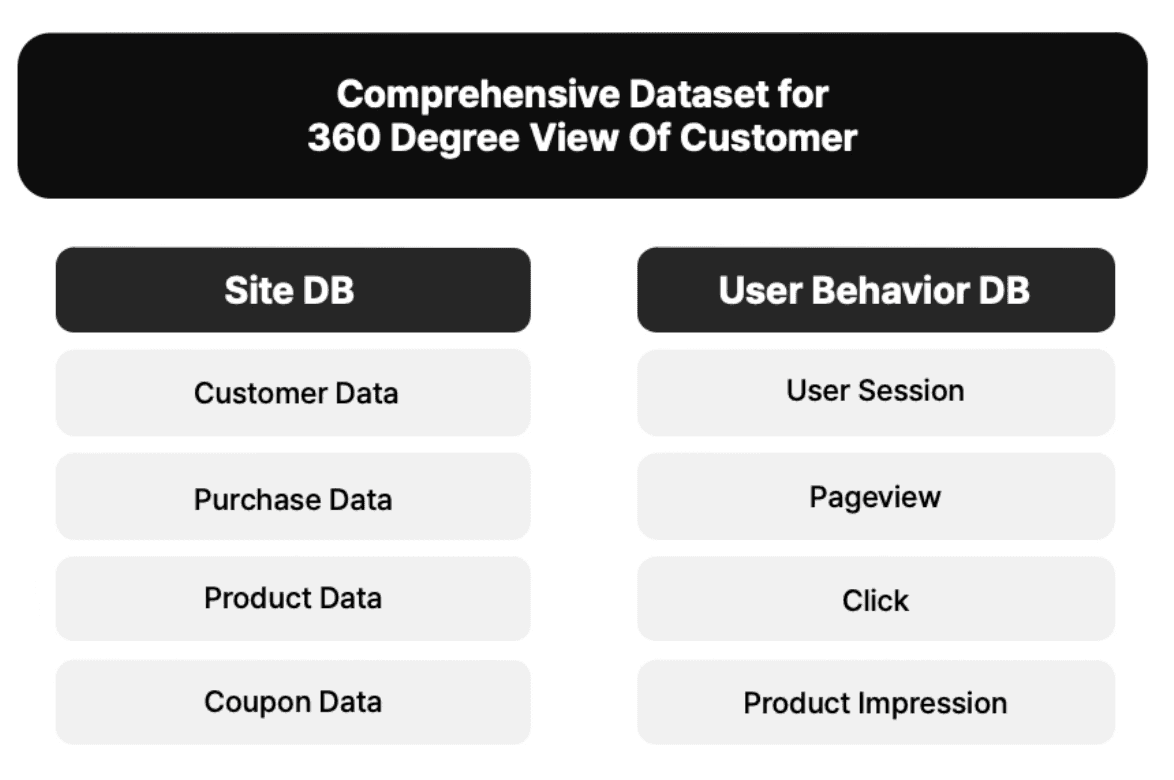
[Foundational data aggregation across Site DB and User Behavior DB for a complete customer view]
From these raw logs, Datarize automatically generates behavioral features—such as visit patterns, interaction intensity, and engagement signals—and connects them to individual user profiles.
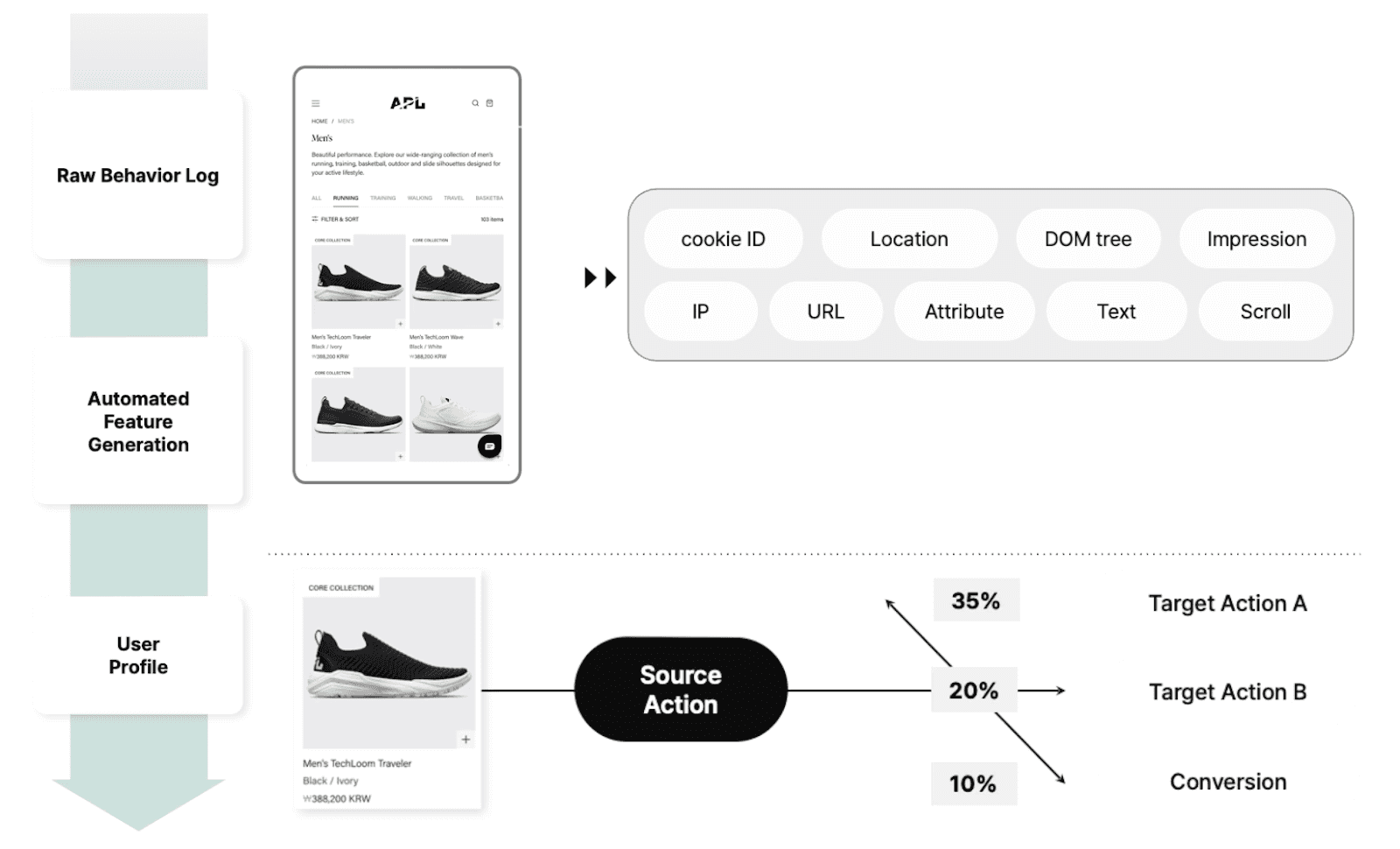
[Turning raw behavior logs into structured user profiles and predictive signals]
These signals are used to power probabilistic models that estimate outcomes such as:
Conversion probability: A 0–100 predictive metric that uses recent user behavior to estimate how likely a visitor is to convert, with higher scores indicating stronger purchase intent.
Churn risk: A predictive metric that estimates the likelihood of churn based on each customer’s individual purchase cycle
Rather than forcing every customer into rigid conditions, Datarize surfaces confidence-based predictions grounded in actual behavior.
How Datarize Enables Autonomous CRM Marketing
Datarize is not a CRM tool layered with AI. It is a CRM marketing solution designed to connect customer understanding directly —so insight does not stop at analysis, but immediately informs action.
Predictive insights flow seamlessly into audience definitions, removing the need for marketers to manually rebuild segments or translate analysis into execution logic. These audiences are continuously updated based on live customer behavior, ensuring that targeting reflects real intent rather than static rules.
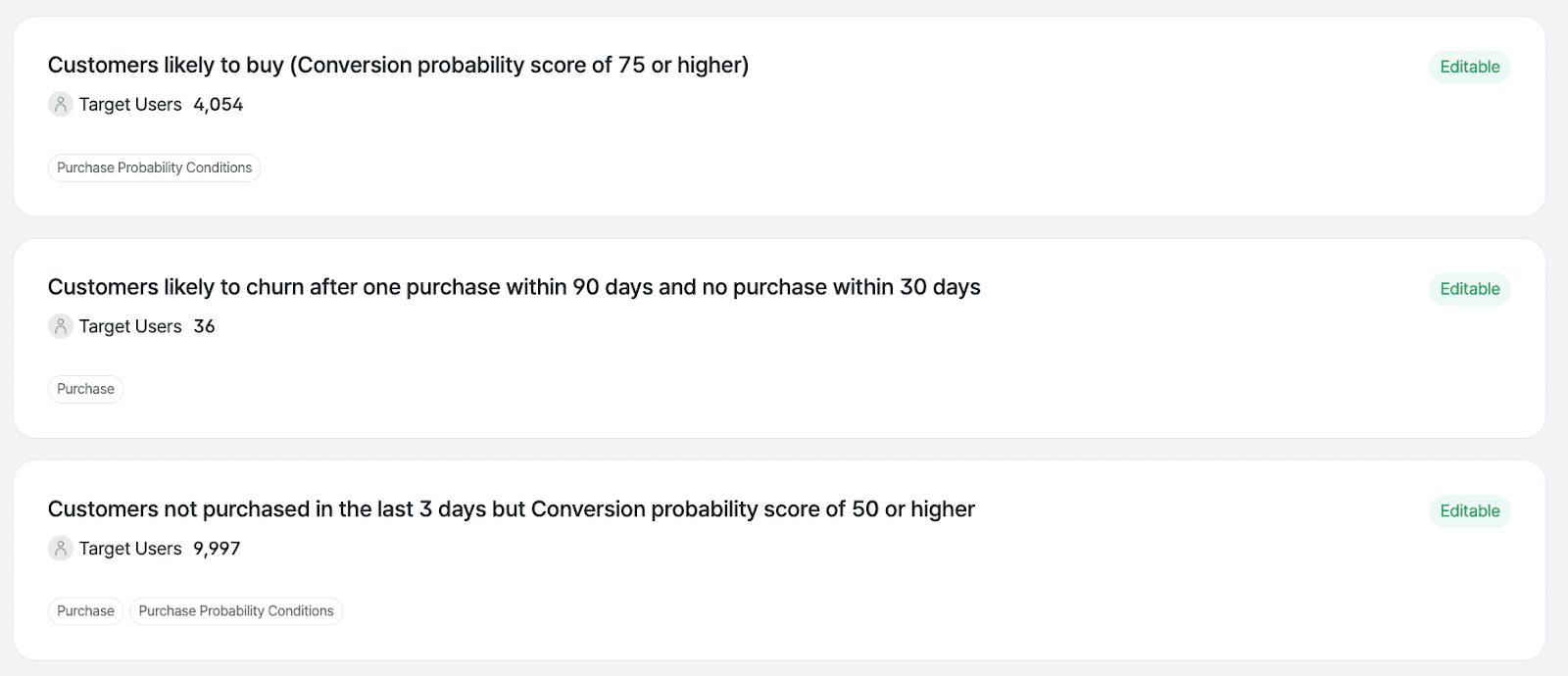
[Datarize’s AI-recommended audience segments, ready to activate instantly]
From there, execution happens in the same flow. Campaigns can be launched directly from insights—without exports, tool switching, or operational handoffs. Because campaign recommendations are informed not only by past performance but by forward-looking probability signals, teams can act while customer intent is still present.
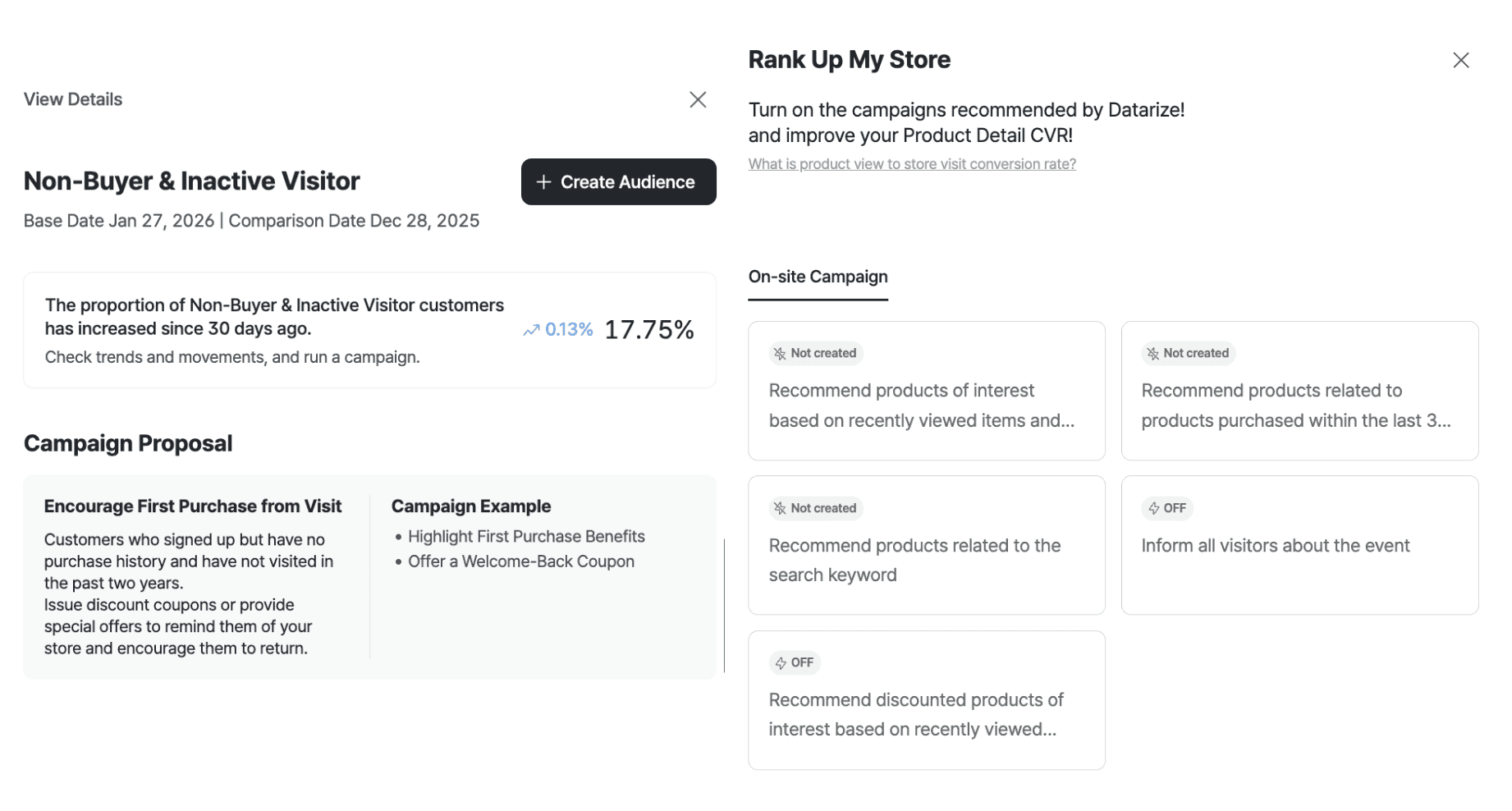
[Datarize’s AI-powered campaign recommendations, generated from site behavior and predictive insights—ready to launch in one click]
This autonomy delivers measurable impact in practice. Brands that activate Datarize’s preset on-site popup campaigns see an average 8% lift in revenue, achieved without ongoing manual optimization. Message campaigns driven by Datarize’s predictive audiences have delivered average ROAS of up to 3,835%, reflecting the advantage of acting at the right moment rather than reacting after the fact.
This is where AI stops being merely supportive and starts becoming autonomous. Insight, decision, and execution operate as a single continuous loop—reducing manual work, accelerating response time, and delivering performance that manual orchestration struggles to match at scale.
AI That Drives Growth, Not Just Insight
AI is not becoming less important in CRM marketing. If anything, expectations around AI are getting higher.
What brands are no longer willing to accept is AI that only explains what happened. The real demand is for solutions that reduce friction—between data and insight, insight and decision, and decision and execution.
This is why autonomy matters. Not because it removes human involvement, but because it consistently performs at a level that manual workflows struggle to match. Just as autonomous driving proved its value by being reliable and effective at scale, autonomous CRM marketing earns trust by delivering measurable outcomes with less operational overhead.
Datarize is built for this shift. By learning from the full spectrum of customer behavior and connecting predictive insight directly to execution, it allows marketing teams to move faster, act with confidence, and focus on growth rather than orchestration.
Related Articles
함께 보면 좋은 컨텐츠




매주 발행되는 데이터라이즈 뉴스레터